
Table of Contents
ToggleIntroduction
If your laptop has become painfully slow, you’re not alone. I’ve seen people blame everything from Windows updates to old hardware, then spend money on upgrades that barely changed anything. The problem usually isn’t that the laptop is “too old.” The real problem is not knowing what is slowing down your laptop in the first place.
A slow laptop almost always leaves clues. Maybe it freezes only when you open Chrome. Maybe the fan gets loud after twenty minutes. Maybe it takes forever to boot, but once it starts, it feels fine. Those small details matter because they point toward the real bottleneck.
That’s why the first step isn’t searching for random speed hacks. Before clearing temporary files, disabling startup apps, or buying more RAM, you need to check what’s slowing down your laptop. Once you know whether it’s high CPU usage, RAM usage, disk usage, startup programs, background apps, overheating, or even a failing SSD, fixing the problem becomes much easier—and often much cheaper.
Think of it like visiting a doctor. You wouldn’t start taking medicine without knowing what’s causing the illness. Your laptop deserves the same approach. Diagnose first. Fix second.
In this guide, I’ll show you how to check what’s slowing down my laptop using built-in Windows tools like Task Manager, Resource Monitor, and a few practical checks that many guides completely ignore. By the end, you’ll know exactly where your laptop is struggling and which fix is actually worth your time. Microsoft Task Manager documentation
How do I check what’s slowing down my laptop? (Quick Answer)
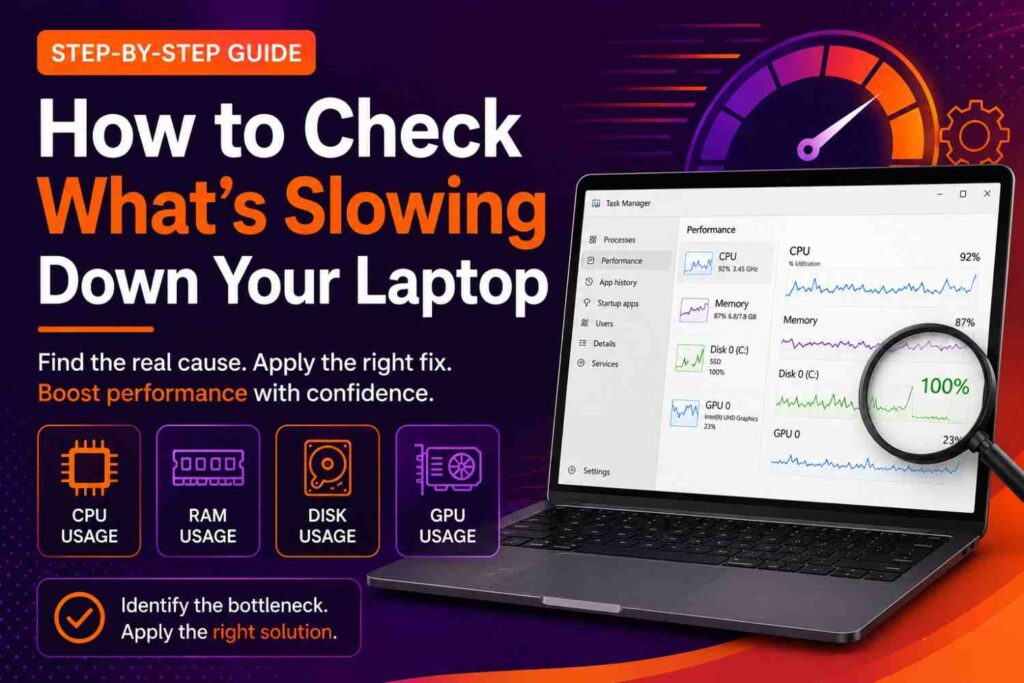
The fastest way to check what’s slowing down your laptop is to open Task Manager (Ctrl + Shift + Esc) and monitor CPU, Memory, Disk, and GPU usage while your laptop feels slow. Then check startup programs, available storage, background apps, temperatures, and Windows processes to identify the resource causing the bottleneck. Once you know which component is overloaded, you can apply a targeted fix instead of guessing.
Most articles stop after telling you to “open Task Manager.” That’s only half the story.
A spike in CPU usage isn’t always a processor problem. High disk usage doesn’t automatically mean your SSD is failing. Low available RAM may be caused by a memory-hungry browser, while poor performance after thirty minutes could point to thermal throttling rather than weak hardware.
The rest of this guide walks through each possibility in a logical order. Instead of trying random fixes, you’ll learn how to identify what’s slowing down your laptop, understand the clues your system is giving you, and confidently decide whether the issue is software, hardware, or simply a setting that needs attention.
Before You Start: Don’t Try Fixes Yet
Here’s something I wish more troubleshooting guides talked about.
Most people don’t actually fix a slow laptop—they accidentally mask the symptom.
The moment a laptop starts lagging, the internet tells you to clear temporary files, disable startup programs, buy more RAM, or install a “PC cleaner.” Sometimes those things help. Sometimes they don’t. The frustrating part is that you never learn what was actually slowing down your laptop.
If your goal is to check what’s slowing down your laptop, resist the urge to change anything for a few minutes. Your laptop is already telling you where it’s struggling. You just need to catch it in the act.
Think Like a Detective, Not a Mechanic
Imagine your car makes a strange noise.
You wouldn’t immediately replace the engine. You’d first notice:
When does the noise happen?
Is it only while accelerating?
Does it disappear after warming up?
Is it coming from one side?
Your laptop works the same way.
The timing of the slowdown often reveals more than the slowdown itself.
Observe First. Fix Second.
Laptop Feels Slow
        │
        ▼
Don't change anything yet
        │
        ▼
Watch what happens
        │
        ├── CPU spikes?
        ├── RAM fills up?
        ├── Disk stays at 100%?
        ├── Fan suddenly gets louder?
        ├── Only one app freezes?
        └── Only happens after 20–30 minutes?
        │
        ▼
Find the real bottleneck
        │
        ▼
Apply the right fix
That single change in approach can save hours of trial and error.
Why Random Fixes Often Fail
A laptop can feel slow for dozens of different reasons, but only one or two are usually responsible.
Here’s where people commonly go wrong.
| What people assume | What could actually be happening |
|---|---|
| I need more RAM. | A browser extension, memory leak, or dozens of background apps are consuming available memory. |
| My processor is weak. | A Windows Update, antivirus scan, or another process is temporarily driving high CPU usage. |
| My SSD is full. | The real issue is excessive disk usage, search indexing, or cloud syncing—not storage capacity itself. |
| Closing apps fixed it. | The slowdown disappeared temporarily, but the underlying cause remains and will return. |
| My laptop is old. | Dust buildup, thermal throttling, outdated drivers, or poor power settings are reducing performance. |
Notice a pattern?
The symptom and the cause are often different.
Don’t Let One Number Fool You
One mistake I see repeatedly is opening Task Manager, spotting a high number, and assuming that’s the problem.
For example:
95% CPU usage doesn’t automatically mean your processor is too slow.
90% RAM usage doesn’t always mean you need a memory upgrade.
100% disk usage doesn’t necessarily mean your SSD or HDD is failing.
A loud fan doesn’t always mean overheating is causing the slowdown.
Those numbers are clues—not conclusions.
Context matters.
If your CPU usage jumps to 95% for three seconds while opening Photoshop, that’s perfectly normal.
If it sits above 90% for fifteen minutes while you’re only browsing the web, now you have something worth investigating.
The same applies to RAM usage, GPU usage, and disk activity. Don’t react to a single snapshot. Watch what happens over a few minutes while your laptop is actually running slow.
Look for Patterns, Not Isolated Events
One of the fastest ways to identify what’s slowing down your laptop is to ask a simple question:
“When does it become slow?”
That answer often points you toward the correct diagnosis.
| When the slowdown happens | Likely direction to investigate |
|---|---|
| Right after startup | Startup programs, background services, Windows Update |
| After 20–30 minutes | Overheating or thermal throttling |
| While opening Chrome | Browser extensions, RAM usage, memory leaks |
| During gaming | GPU usage, CPU usage, cooling system |
| While copying files | SSD/HDD health, disk usage |
| Only when charging | Power plan, charger, battery management |
| After a recent update | Drivers, Windows Update, system conflicts |
This is why simply searching “why is my laptop running slow” rarely gives the right answer. The same symptom can have completely different causes depending on when it appears.
One Bottleneck Can Slow Everything Else
Here’s another insight that’s easy to miss.
Your laptop doesn’t always have multiple problems. Quite often, it has one bottleneck that’s creating a chain reaction.
One Hidden Problem
        │
        ▼
High Disk Usage
        │
        ▼
Apps wait longer to load
        │
        ▼
RAM fills while waiting
        │
        ▼
CPU spends more time processing
        │
        ▼
Laptop feels slow everywhere
This is why replacing hardware without diagnosing the bottleneck can be disappointing. The upgrade may improve one component while leaving the real cause untouched.
The Mindset That Saves Time and Money
Before you install another optimization tool or order new hardware, pause for a moment.
Your objective isn’t to make the laptop faster yet. Your objective is to find out what’s slowing down your laptop.
Once you identify the real bottleneck—whether it’s CPU usage, RAM usage, disk usage, startup programs, background apps, Windows Resource Monitor, thermal throttling, or SSD health—the right fix usually becomes obvious.
The next section is where we’ll start collecting that evidence, beginning with the slowdown pattern your laptop is already showing you. That pattern is often the biggest clue of all.
Step 1 — Describe When Your Laptop Becomes Slow
Your Slowdown Pattern Is Your Biggest Clue
This might sound strange, but before opening Task Manager or checking CPU usage, answer one simple question:
When does your laptop actually become slow?
Most people focus on how slow it feels.
I pay more attention to when it happens.
That small difference changes everything.
I’ve seen people replace perfectly good SSDs because their laptop lagged after an hour of use. The SSD wasn’t the problem. Dust had clogged the cooling vents, the processor was overheating, and thermal throttling kicked in every afternoon.
I’ve also seen laptops that felt painfully slow for the first five minutes after startup. People blamed old hardware, but Windows was quietly installing updates, syncing cloud files, and launching ten background applications at once.
The slowdown wasn’t random.
It had a pattern.
Once you recognize that pattern, you’ve already eliminated half the possible causes.
Don’t Ask “Why Is My Laptop Slow?”
Ask this instead:
“Exactly when does my laptop become slow?”
That’s the question that helps you check what’s slowing down your laptop instead of chasing random fixes.
Think about the last few days.
Did it happen…
every single time you turned it on?
only after opening Chrome?
while editing videos?
after connecting your charger?
after a recent Windows Update?
after running for thirty minutes?
Your answers are evidence.
Slowdown Pattern Cheat Sheet
Use this table before changing any settings. It helps you identify what’s slowing down your laptop much faster.
| When it becomes slow | Most likely cause | What to check first |
|---|---|---|
| Immediately after startup | Too many startup programs, Windows Update, cloud sync, antivirus scan | Startup Apps in Task Manager |
| Only while gaming | High GPU usage, CPU bottleneck, overheating, outdated graphics driver | GPU usage, CPU usage, temperatures |
| Only in Chrome or Edge | Memory-hungry tabs, browser extensions, hardware acceleration issue | RAM usage, browser Task Manager, extensions |
| About 20–30 minutes after turning on | Thermal throttling, dust buildup, cooling problem | CPU temperature, fan behavior |
| Only while charging | Wrong power plan, battery issue, charger limitation | Windows Power Options, battery health |
| Right after a Windows Update | Background optimization, driver conflicts, indexing | Windows Update history, Disk usage |
| Random freezing every few minutes | Failing SSD/HDD, corrupted system files, driver issue | SSD health, Event Viewer, System File Checker |
| Only with many browser tabs open | Insufficient RAM, memory leak, browser cache overload | Memory usage, Resource Monitor |
| While copying large files | High disk usage, storage drive issue | Disk activity, SSD/HDD health |
| During video calls | CPU overload, webcam software, background apps | CPU usage, background processes |
| Whenever cloud storage syncs | OneDrive, Google Drive, Dropbox synchronization | Sync status, Disk usage, Network usage |
Here’s What Those Patterns Usually Mean
Instead of memorizing technical terms, think of your laptop like someone trying to finish several jobs at once.
If it’s only slow after startup…
Your laptop isn’t tired.
It’s busy.
Windows may be launching updates, indexing files, syncing OneDrive, opening startup apps, and running antivirus scans simultaneously.
If performance improves after five or ten minutes, the hardware probably isn’t your biggest problem.
If it slows down after 30 minutes…
This is one of my favorite clues because so many people overlook it.
Hardware doesn’t suddenly become weaker after half an hour.
Heat builds gradually.
As temperatures rise, modern processors reduce their own speed to protect themselves.
That’s called thermal throttling.
The result?
Your laptop feels slower even though no new apps are running.
If Chrome is the only problem…
Don’t immediately blame Chrome.
Ask another question.
Is it one website?
One extension?
Fifty open tabs?
Or is Chrome simply exposing that your laptop is already running out of available RAM?
This is why checking memory usage is far more useful than reinstalling the browser.
If gaming is the only time it’s slow…
This isn’t just about graphics.
Gaming stresses almost every part of your laptop.
CPU
GPU
RAM
Cooling system
Storage
A single overloaded component can create a bottleneck that makes everything feel sluggish.
If it became slow after a Windows Update…
Don’t panic.
Many updates continue working in the background even after the restart.
Windows may still be:
rebuilding its search index
optimizing files
updating security components
downloading additional updates
Give it some time before assuming the update “broke” your laptop.
Pattern Before Performance
Here’s a simple way to think about it.
Laptop feels slow
        │
        ▼
WHEN does it happen?
        │
        ├── After startup
        ├── During gaming
        ├── In Chrome
        ├── After 30 minutes
        ├── While charging
        ├── After Windows Update
        └── Randomly
                │
                ▼
Each pattern points toward a different bottleneck
                │
                ▼
Now verify it with Task Manager
Notice something?
We haven’t clicked a single button yet.
And yet you’ve already narrowed the list of possible causes dramatically.
That’s exactly how professionals troubleshoot systems. They don’t start by fixing things—they start by spotting patterns.
In the next step, we’ll open Task Manager and learn how to confirm those clues using CPU usage, RAM usage, disk usage, GPU usage, and other real-time performance data. This is where you’ll move from educated guesses to solid evidence about what is slowing down your laptop.
Step 2 — Check Resource Usage in Task Manager
How to Identify Which Resource Is Actually Slowing Down Your Laptop
If someone asked me how to check what’s slowing down my laptop, this is the first tool I’d open.
Not because Task Manager magically fixes anything.
Because it shows you what your laptop is trying to tell you.
The mistake most people make is opening Task Manager, seeing one number at 100%, panicking, and closing it two seconds later.
That’s like checking your heart rate while sprinting and deciding something is wrong.
Your laptop is constantly working. The goal isn’t to find activity—it’s to find abnormal activity that doesn’t go away.
Open Task Manager the Right Way
Press
Ctrl + Shift + Esc
or
Right-click the taskbar → Task Manager
If you only see a small window, click More details.
Now open the Processes tab.
You’ll see something similar to this.
--------------------------------------------------------------
Process                CPU     Memory     Disk      GPU
--------------------------------------------------------------
Chrome                 18%      2.4 GB      0%       4%
Windows Explorer        2%       95 MB      0%       0%
Antimalware Service    24%      380 MB      5 MB/s   0%
Discord                 3%      410 MB      0%       0%
--------------------------------------------------------------
Don’t stare at every process.
Instead, look at the four columns across the top.
CPU
Memory
Disk
GPU
One of these is usually trying much harder than the others.
That’s your first clue.
If you’re unsure whether your processor, memory, or storage is the main bottleneck, try our Laptop Performance Bottleneck Analyzer. It compares your system resources and helps identify which component is limiting performance.
Don’t Chase Peaks. Watch for Patterns.
This is one of the biggest mistakes I see.
People notice CPU jump to 100% while opening Photoshop.
Then they conclude:
“My processor is too slow.”
Not necessarily.
Applications often need extra resources while launching.
What matters is what happens after everything finishes loading.
A healthy laptop experiences short bursts of activity.
An unhealthy laptop stays overloaded.
Think of it this way.
Healthy Resource Usage

CPU
100% |       /\        /\
 80% |      /  \      /
 60% |_____/    \____/________
 40% |
 20% |
  0% |________________________


Problem Resource Usage

CPU
100% |────────────────────────
 90% |────────────────────────
 80% |────────────────────────
 60% |
 40% |
 20% |
  0% |________________________
Short spikes are normal.
Constant pressure isn’t.
CPU Usage: Your Laptop’s Workload
The CPU is your laptop’s decision-maker.
Every click, calculation, browser tab, and background process eventually reaches it.
But high CPU usage doesn’t automatically mean your processor is weak.
It simply means something is asking it to work very hard.
Normal CPU behavior
✅ Brief jump while opening software
✅ Temporary spike during Windows Update
✅ Higher usage while exporting videos
✅ Returning to lower levels after work finishes
These are expected.
When CPU usage becomes a problem
Watch for situations like these.
| CPU behavior | What it usually means |
|---|---|
| Above 90% for several minutes while doing almost nothing | Background process stuck or runaway application |
| One app constantly using most of the CPU | That application is likely the bottleneck |
| CPU stays high after closing all visible apps | Hidden background services, malware, Windows processes, or driver issues |
| CPU climbs slowly as you use the laptop | Possible overheating or memory-related slowdown |
Unique tip
Instead of looking only at the percentage, sort the CPU column.
If the top process keeps changing every second, your workload is probably normal.
If the same application sits at the top for ten minutes, investigate that application first.
Memory Usage (RAM): The Laptop’s Short-Term Workspace
People often assume
High RAM usage = Buy more RAM.
That’s one of the most expensive guesses you can make.
RAM isn’t a storage problem.
It’s workspace.
Imagine your desk.
A messy desk doesn’t mean you need a bigger office.
Sometimes you just have too many things open.
Normal memory usage
Modern Windows systems often use a surprisingly large amount of RAM even when idle.
That’s not automatically bad.
Windows caches frequently used files to make programs open faster later.
Unused RAM is often wasted RAM.
When memory becomes the bottleneck
| Memory behavior | Likely explanation |
|---|---|
| Memory stays above 90% while switching between apps | Too many active programs or insufficient RAM |
| Browser alone uses several gigabytes | Heavy websites, extensions, or many tabs |
| Memory keeps increasing even without opening new apps | Possible memory leak |
| Laptop pauses while changing applications | Windows is moving data between RAM and storage |
A useful clue:
If RAM usage remains high and Disk usage suddenly increases, Windows may be using your SSD or HDD as virtual memory.
That’s why the whole laptop suddenly feels sluggish.
Many articles explain RAM.
Very few explain what happens immediately afterward.
Disk Usage: The Most Misunderstood Number
This one confuses people more than anything else.
They see
Disk = 100%
Then assume
“My SSD is dying.”
Not necessarily.
Disk usage measures how busy the drive is, not how full it is.
A perfectly healthy SSD can briefly hit 100%.
The problem is when it stays there for several minutes without an obvious reason.
Normal disk activity
Installing software
Copying large files
Windows Update
Antivirus scans
Cloud synchronization
These naturally increase disk usage.
Warning signs
| Disk behavior | Possible cause |
|---|---|
| 100% disk usage while the laptop is idle | Background process stuck |
| Constant activity even after startup | Windows Search indexing, updates, cloud sync |
| Disk usage high but transfer speed very low | Aging HDD or storage problem |
| Clicking anything causes long delays | Storage bottleneck or failing drive |
Here’s something many guides don’t mention.
If your laptop feels slow only while files are opening, your bottleneck is often storage—not CPU or RAM.
GPU Usage: Important Beyond Gaming
People usually ignore the GPU unless they play games.
That’s a mistake.
Modern browsers, video calls, editing software, AI applications, and even Windows animations all use graphics processing.
High GPU usage isn’t bad.
Unexpected GPU usage is.
Look for these clues
| GPU behavior | Possible explanation |
|---|---|
| High GPU only while gaming | Normal |
| GPU active while watching videos | Normal hardware acceleration |
| GPU constantly busy on desktop | Driver issue or background application |
| GPU usage increases with browser tabs | Hardware acceleration or graphics-heavy websites |
If you’re wondering what is making my laptop slow during video editing or gaming, compare GPU usage with CPU usage.
If one stays maxed out while the other remains relatively low, you’ve likely found your bottleneck.
Read the Resources Together, Not Separately
The biggest insight I can share is this:
Don’t diagnose one number.
Diagnose the relationship between all four.
                          Laptop Running Slow
                                  │
             ┌────────────────────┼────────────────────┐
             │                    │                    │
        CPU High             RAM High            Disk High
             │                    │                    │
             ▼                    ▼                    ▼
   Background process      Too many apps       Storage bottleneck
   Driver issue            Memory leak         Windows Update
   Thermal throttling      Browser overload    SSD/HDD issue
             │                    │                    │
             └────────────────────┼────────────────────┘
                                  │
                                  ▼
                      Check GPU usage as confirmation
                                  │
                                  ▼
                    Identify the real bottleneck first
For example:
High CPU + Low Disk + Normal RAM → A processor-intensive application is likely responsible.
High RAM + High Disk + Low CPU → Windows is probably relying on virtual memory because available RAM is exhausted.
High Disk + Normal CPU + Normal RAM → Storage activity is slowing everything down.
High GPU + High CPU only during gaming → That’s expected under load, unless temperatures become excessive.
The goal isn’t to find a scary number. The goal is to understand which resource stays overloaded long enough to affect performance.
Now that you’ve learned how to read CPU usage, memory usage, disk usage, and GPU usage, the next step is even more useful. We’ll connect those numbers to real-world causes so you can identify the single bottleneck that’s actually slowing down your laptop instead of treating every symptom as a separate problem.
Lorem ipsum dolor sit amet, consectetur adipiscing elit. Ut elit tellus, luctus nec ullamcorper mattis, pulvinar dapibus leo.
Step 3 — Look for the Real Bottleneck
Every Slow Laptop Usually Has One Main Bottleneck
This is where a lot of troubleshooting goes off track.
People notice five different symptoms and assume they have five different problems.
- The browser feels slow.
- Files take forever to open.
- The fan is loud.
- Videos stutter.
- Apps freeze.
It looks like everything is broken.
In reality, there’s often one bottleneck causing a domino effect.
Think of a highway. One blocked lane creates traffic for miles. The cars behind it aren’t the problem—the blockage is.
Your laptop works the same way.
The goal isn’t to list every symptom. The goal is to answer one question:
What is the first thing that’s slowing everything else down?
Once you know what is slowing down your laptop, the rest becomes much easier.
Find the First Domino
Don’t look at symptoms in isolation.
Start with the resource that stays overloaded the longest.
Laptop feels slow
        │
        ▼
Which resource stays overloaded?
        │
 ┌──────┼─────────┬─────────┬─────────┐
 │      │         │         │
CPU    RAM      Disk      GPU
 │      │         │         │
 ▼      ▼         ▼         ▼
Find the process causing it
        │
        ▼
Fix the bottleneck
        │
        ▼
Recheck laptop performance
Notice something?
We’re not trying ten different fixes.
We’re following evidence.
Bottleneck Diagnosis Table
Use this as a quick reference whenever you’re trying to identify what’s slowing down your laptop.
| Symptom | Most Likely Cause | First Thing to Check |
|---|---|---|
| CPU stays above 90% for several minutes | Heavy application, Windows Update, antivirus scan, malware, thermal throttling | Sort processes by CPU usage in Task Manager |
| Memory (RAM) above 90% | Too many browser tabs, memory leak, background apps | Check RAM usage and close the largest memory users |
| Disk usage stays at 100% | Windows Update, indexing, antivirus scan, failing HDD, cloud sync | Wait a few minutes, then identify which process is using the disk |
| GPU usage stays high on desktop | Graphics driver issue, browser hardware acceleration, background software | Sort by GPU usage and update graphics drivers if needed |
| Fan becomes loud before performance drops | Dust buildup, overheating, blocked vents | Check temperatures and airflow |
| Laptop freezes while opening files | Slow HDD, SSD health issue, storage bottleneck | Check disk usage and drive health |
| Everything slows after 20–30 minutes | Thermal throttling | Monitor temperatures while working |
| Laptop only slows after login | Startup programs or background services | Review Startup Apps and background processes |
| Internet feels slow but CPU and RAM are normal | Network issue, browser extensions, cloud syncing | Test network separately before blaming the laptop |
Don’t Treat the Symptom—Treat the Cause
Let’s look at a few real-world examples.
Example 1: 100% Disk Usage
Many people immediately think:
“My SSD is failing.”
Not so fast.
Ask yourself:
- Is Windows installing updates?
- Is OneDrive syncing thousands of files?
- Is Windows Search rebuilding its index?
- Is an antivirus running a full scan?
If yes, don’t interrupt it immediately.
Sometimes the best fix is simply letting Windows finish what it’s already doing.
100% Disk Usage
        │
        ▼
Windows Update running?
        │
   Yes ─────► Let it finish
        │
        No
        │
        ▼
Check which process is using the disk
Example 2: High CPU Usage
A laptop with high CPU usage isn’t always underpowered.
I’ve seen RGB lighting software consume more processor time than professional editing software.
I’ve also seen browser tabs quietly running AI tools, video ads, or poorly designed websites that pushed CPU usage above 80%.
Before blaming the processor, ask:
- Is one application responsible?
- Is it a temporary spike?
- Does CPU usage return to normal after closing that app?
If yes, the processor isn’t your problem.
The software is.
Example 3: High RAM Usage
Suppose your laptop shows 92% RAM usage.
That doesn’t automatically mean you should buy another memory stick.
Instead, ask:
- Do you have 60 Chrome tabs open?
- Is one browser extension leaking memory?
- Is one application using several gigabytes?
Sometimes closing a single misbehaving application frees more RAM than upgrading your laptop would.
Example 4: Loud Fan and Slow Performance
This one catches people all the time.
They hear the fan.
They assume the fan is making noise because it’s broken.
Usually, the fan is doing exactly what it’s should.
It’s trying to cool hardware that’s already overheating.
The fan isn’t causing the slowdown.
It’s reacting to it.
The real issue could be:
- blocked air vents
- dried thermal paste
- dust inside the cooling system
- heavy CPU workload
The fan is a clue—not the culprit.
The Bottleneck Chain
One overloaded component rarely stays isolated.
Background process
        │
        ▼
CPU stays busy
        │
        ▼
Apps respond slower
        │
        ▼
RAM fills while waiting
        │
        ▼
Disk works harder
        │
        ▼
Laptop feels slow everywhere
That’s why fixing the first bottleneck often makes several symptoms disappear at once.
Don’t Ignore the “When”
One trick I rely on is combining Task Manager with the slowdown pattern you identified earlier.
| If this happens… | Suspect… |
|---|---|
| CPU spikes only while exporting videos | Normal workload |
| CPU stays high while idle | Background process or malware |
| Disk reaches 100% only after startup | Windows Update or indexing |
| RAM fills after opening Chrome | Browser tabs or extensions |
| Performance drops after 30 minutes | Thermal throttling |
| Laptop slows only while gaming | GPU or cooling bottleneck |
Looking at when the problem appears alongside CPU usage, RAM usage, disk usage, and GPU usage gives you a much clearer picture than either one alone.
The Biggest Mistake I See
People often try to fix everything at once.
They:
- uninstall programs,
- disable Windows services,
- clear temporary files,
- install PC cleaners,
- update drivers,
- buy RAM,
…all before identifying the real cause.
When performance improves, they never know which change actually worked.
The next time the laptop slows down, they’re back to guessing.
That’s why the best approach is simple:
- Observe the slowdown.
- Identify the bottleneck.
- Change one thing.
- Test again.
You’ll reach the answer much faster—and you’ll understand how to check what’s slowing down your laptop the next time it happens.
Step 4 — Check Startup Programs
Startup Programs Can Slow Your Laptop Before You Even Touch It
If your laptop feels sluggish within the first few minutes after signing in, don’t blame the hardware yet.
One of the most overlooked causes is startup programs.
Every application that launches automatically is competing for the same resources:
- CPU time
- RAM
- Disk activity
- Network bandwidth
Individually they don’t seem like much.
Together they can make a fast laptop feel surprisingly slow.
How Many Startup Apps Are Too Many?
There isn’t a perfect number because it depends on what those apps actually do.
Five lightweight utilities may have almost no impact.
Three heavy applications can noticeably delay startup.
Instead of counting apps, pay attention to their Startup impact rating in Task Manager.
As a practical rule:
| Number of Startup Apps | General Impact |
|---|---|
| 0–5 | Usually fine for most users |
| 6–10 | Worth reviewing, especially on older laptops |
| More than 10 | Often worth trimming if several have medium or high impact |
A laptop with an SSD and 32 GB of RAM will handle more startup apps than an older laptop with a hard drive and 8 GB of RAM.
Context matters.
If your laptop suddenly became slow after previously working well, you may also want to read Why Is My Laptop So Slow All of a Sudden?
How to Check Startup Programs
Open:
Task Manager → Startup Apps
You’ll see something similar to this.
| Application | Startup Impact | Keep Enabled? |
|---|---|---|
| Windows Security | Low | ✅ Yes |
| OneDrive | Low | ✅ If you use it |
| NVIDIA Control Panel | Low | ✅ Usually |
| Steam | Medium | ❌ Optional |
| Spotify | Medium | ❌ Optional |
| Discord | Medium | ❌ Optional |
| Adobe Creative Cloud | High | ❌ If you don’t need it immediately |
| Microsoft Teams | High | ❌ Optional for many users |
Don’t disable apps just because they appear here.
Ask one question:
Do I need this every single time I start my laptop?
If the answer is no, it probably doesn’t need to launch automatically.
Startup Apps You Should Usually Leave Alone
Some programs support security, drivers, or hardware features.
They’re generally worth keeping enabled.
| Usually Keep Enabled | Why |
|---|---|
| Windows Security | Protects your system in real time |
| Touchpad or keyboard drivers | Ensures hardware works correctly |
| Audio drivers (Realtek, Nahimic, etc.) | Enables full audio functionality |
| Graphics drivers (Intel, AMD, NVIDIA) | Supports display and GPU features |
| Battery or laptop manufacturer utilities | May control charging, fan profiles, or function keys |
Disabling these rarely speeds up your laptop in a meaningful way and can sometimes remove useful functionality.
Startup Apps You Can Often Disable
These are common examples that many people don’t need running immediately after login.
- Spotify
- Discord
- Steam
- Epic Games Launcher
- Adobe Creative Cloud
- Microsoft Teams (if you don’t use it daily)
- Zoom
- Skype
- Chat applications you rarely open
- RGB lighting software that isn’t essential
Disabling them doesn’t uninstall anything.
It simply stops them from launching automatically.
You can still open them whenever you want.
A Better Habit Than Disabling Everything
Here’s something I do on my own laptop.
Every couple of months, I open the Startup Apps list and ask:
“Have I actually used this application in the last month?”
If the answer is no, it doesn’t deserve a place in startup.
That five-minute review often has a bigger impact than installing another optimization tool.
The goal isn’t to have zero startup programs.
The goal is to make sure every startup app has earned its place. That’s a smarter way to check what’s slowing down your laptop and keep it responsive every time you turn it on.
Step 5 — Is Heat Making Your Laptop Slow?
Your Laptop Can Be Overheating Even If It Doesn’t Feel Hot
This surprised me the first time I saw it.
A laptop owner told me,
“It can’t be overheating. The fan isn’t even loud.”
Ten minutes later, the CPU had already reduced its speed to protect itself.
The laptop wasn’t broken.
It was protecting itself from heat.
That’s something many people miss when trying to check what’s slowing down my laptop.
They wait for obvious signs like a loud fan or a burning-hot keyboard.
In reality, thermal throttling often starts quietly.
By the time you hear the fan working overtime, your laptop may already have been running slower for several minutes.
What Is Thermal Throttling?
Let’s keep this simple.
Every processor has a safe operating temperature.
When it starts getting too hot, Windows doesn’t magically cool it down.
Instead, the processor slows itself down.
Less speed means less heat.
Less heat means less risk of damage.
Think of it like this.
CPU gets hotter
        │
        ▼
Temperature reaches safety limit
        │
        ▼
Processor automatically reduces speed
        │
        ▼
Laptop becomes slower
        │
        ▼
Temperature gradually drops
Nothing is broken.
Your laptop is doing exactly what it was designed to do.
A loud cooling fan is often one of the earliest clues that heat is reducing performance. I explain the warning signs in Why Is My Laptop Fan So Loud?
The Biggest Myth About Overheating
Most people believe this.
Loud fan = overheating.
The truth is often the opposite.
The fan is simply responding to rising temperatures.
The slowdown usually starts before the fan reaches full speed.
That’s why someone might say,
“My laptop feels sluggish, but it isn’t making much noise.”
A few minutes later…
The fan speeds up.
Performance drops even more.
At that point, the cooling system is trying to catch up.
Signs Heat Is Probably the Real Bottleneck
If several of these sound familiar, overheating deserves your attention.
| What you notice | What it often means |
|---|---|
| Laptop starts fast but slows after 20–40 minutes | Thermal throttling |
| Games become less smooth over time | CPU or GPU reducing speed because of heat |
| Video exports begin quickly but finish slowly | Processor temperature increasing |
| Keyboard area becomes noticeably warm | Internal components generating excess heat |
| Performance improves after shutting down for a while | Laptop cooled down during the break |
| Fan speed keeps increasing during simple tasks | Cooling system struggling to remove heat |
Notice that none of these require the laptop to feel extremely hot.
That’s why heat is one of the easiest causes to overlook when trying to identify what’s slowing down your laptop.
Why Does Heat Build Up?
Heat isn’t always caused by demanding software.
Sometimes it’s caused by poor airflow.
Common reasons include:
- Dust blocking cooling vents
- Using the laptop on a bed or blanket
- Dried thermal paste on older laptops
- Room temperatures that are already high
- Heavy background processes keeping CPU usage elevated
- Simultaneous CPU and GPU usage during gaming or video editing
Even a healthy laptop can struggle if it can’t get enough cool air.
A Quick Heat Test Anyone Can Do
You don’t need special equipment to gather your first clue.
Try this simple test.
- Restart your laptop.
- Use it normally for 30–45 minutes.
- Pay attention to when it starts slowing down.
- Feel the area above the keyboard or underneath the laptop.
- Listen for changes in fan speed.
Now ask yourself:
- Did performance gradually decline?
- Did the fan become louder later?
- Did the laptop become responsive again after resting?
If the answer is yes, heat deserves a closer look.
Confirm It With Monitoring Software
If you want evidence instead of guesses, monitor your temperatures while the laptop is under load.
Reliable tools include:
- HWiNFO
- HWMonitor
- Core Temp (CPU)
- MSI Afterburner (especially useful for GPU monitoring)
Watch temperatures while doing the activity that causes the slowdown.
If performance drops as temperatures climb, you’ve likely found your bottleneck.
Heat Doesn’t Always Mean Cleaning
This is another misconception.
People immediately open the laptop and start replacing thermal paste.
That’s sometimes necessary—but rarely the first step.
Start with the basics.
Laptop slows after 30 minutes
            │
            ▼
Check CPU temperature
            │
      High temperatures?
            │
      ┌─────┴─────┐
      │           │
     Yes          No
      │           │
Clean vents   Continue checking
Improve airflow RAM, Disk, CPU,
Monitor again Startup apps
Small changes often make a noticeable difference:
- Lift the back of the laptop slightly for better airflow.
- Clean visible dust from vents with compressed air.
- Avoid using the laptop on soft surfaces.
- Reduce unnecessary background apps that keep the processor busy.
These won’t solve every overheating problem, but they’re safe places to start.
Don’t Ignore a Pattern That Keeps Repeating
If your laptop becomes slow at roughly the same amount of time every day, that’s a stronger clue than any single temperature reading.
Heat builds gradually.
So does thermal throttling.
That’s why timing matters just as much as numbers in Task Manager.
When you’re trying to find out what is slowing down your laptop, don’t just ask “How hot is it?”
Ask:
“Does performance always get worse as the laptop gets warmer?”
That question often leads you straight to the real cause
Step 6 — Check Storage the Right Way
A Nearly Full Drive Doesn’t Slow Every Laptop the Same Way
You’ve probably heard this advice dozens of times:
“Keep at least 20% of your storage free.”
It’s not terrible advice.
It’s just incomplete.
Whether low storage affects performance depends on what type of drive you have, how full it is, and what your laptop is doing.
That’s why simply checking the percentage of free space isn’t enough when you’re trying to check what’s slowing down your laptop.
First, Know What Kind of Drive You Have
There are two common storage types.
| SSD (Solid-State Drive) | HDD (Hard Disk Drive) |
|---|---|
| No moving parts | Mechanical spinning disk |
| Much faster | Slower by design |
| Better for Windows and apps | Better for large, inexpensive storage |
| Handles many small files efficiently | Slows more noticeably with random file access |
If your laptop already has an SSD, it’s normal for Windows to feel much snappier than a laptop using an HDD.
But neither drive is immune to slowdowns.
Why a Full SSD Feels Different From a Full HDD
Many people expect both drives to behave the same way.
They don’t.
When an HDD gets nearly full…
The slowdown is usually gradual.
Opening folders, searching files, installing software, and booting Windows often take longer because the drive has to work harder to locate and write data.
When an SSD gets nearly full…
The change can feel less predictable.
For a while, everything may seem perfectly normal.
Then suddenly:
- Windows updates take longer.
- Large file transfers slow down.
- Games load inconsistently.
- Installing software feels sluggish.
- Performance drops during heavy multitasking.
Why?
An SSD needs free space to manage data efficiently. As available space shrinks, the drive has fewer “working areas” to organize new information, so intensive write operations can become slower.
The effect is often most noticeable when you’re copying files, installing programs, or updating Windows—not necessarily while browsing the web.
Storage Capacity vs. Disk Usage
This is where many people get confused.
These are not the same thing.
| Storage Capacity | Disk Usage |
|---|---|
| How much space is available | How busy the drive is right now |
| Measured in GB or % free | Measured as active read/write activity |
| Changes slowly | Can change every second |
| Found in File Explorer | Found in Task Manager |
You might have:
- 500 GB of free space
- but 100% disk usage
Or:
- only 15 GB free
- but almost no disk activity
They’re different measurements answering different questions.
Check More Than Free Space
Instead of looking only at the storage bar in File Explorer, ask yourself:
- Is the drive almost full?
- Is disk usage constantly high?
- Are file transfers unusually slow?
- Does Windows freeze while opening folders?
- Has boot time gradually increased?
Together, those clues paint a much clearer picture of what is slowing down your laptop.
A Practical Storage Checklist
Laptop feels slow
        │
        ▼
Check available storage
        │
        ▼
Less than 10–15% free?
        │
   ┌────┴────┐
   │         │
  Yes        No
   │         │
Free space   Check Task Manager
Remove large files   for Disk Usage
   │         │
   └────┬────┘
        ▼
Is Disk Usage still high?
        │
        ▼
Investigate Windows Update,
cloud sync, antivirus,
or drive health
Hidden Storage Problems Most Guides Skip
Sometimes the drive isn’t actually full.
It’s just busy doing work you never asked it to do.
Look for:
- Windows Search indexing rebuilding after updates
- OneDrive, Google Drive, or Dropbox syncing thousands of files
- Antivirus scanning large folders
- Backup software running in the background
- Windows Update downloading or unpacking files
- Applications creating huge temporary files
These activities increase disk usage even if your SSD has plenty of free space.
When Should You Actually Worry?
Storage deserves closer attention if you notice several of these together:
- Boot time keeps getting longer every month.
- Applications take much longer to install than before.
- Large files copy unusually slowly.
- Windows Explorer frequently stops responding.
- Disk usage remains high even while the laptop is idle.
- The drive reports health warnings through SMART monitoring tools.
At that point, it makes sense to check SSD health or HDD health with a trusted utility. CrystalDiskInfo
The Better Question
Instead of asking,
“Is my drive too full?”
Ask,
“Is my storage preventing my laptop from working efficiently right now?”
That’s a much better way to find out what is slowing down your laptop, because it combines storage capacity, disk usage, drive health, and real-world behavior—not just a single percentage bar.
Step 7 — Check RAM Pressure
Low RAM, Memory Leak, and Browser Tab Overload Are Not the Same Thing
This is one of the most misunderstood parts of laptop troubleshooting.
People open Task Manager, see 90% RAM usage, and immediately decide:
“I need more RAM.”
Sometimes that’s true.
Quite often, it isn’t.
I’ve seen laptops with 8 GB RAM running surprisingly well because the owner kept things simple. I’ve also seen laptops with 32 GB RAM become sluggish because one application quietly consumed memory for hours.
That’s why, if you want to check what’s slowing down your laptop, don’t just ask how much RAM is being used.
Ask why it’s being used.
That one question separates good troubleshooting from expensive guessing.
If you’ve already installed more memory but performance hasn’t improved, read Upgraded RAM But Laptop Still Slow before buying additional hardware.
RAM Pressure vs. Low RAM
Many people treat these as identical.
They’re not.
Imagine your RAM is your kitchen countertop.
If you’re preparing one meal, even a small countertop is enough.
If you’re cooking for twenty people, even a huge countertop fills up quickly.
The problem isn’t always the countertop.
Sometimes it’s simply too much happening at once.
That’s exactly how RAM works.
Three Problems That Look the Same—but Aren’t
| Problem | What’s Actually Happening | Typical Fix |
|---|---|---|
| Low RAM | Your laptop genuinely doesn’t have enough memory for your workload. | Upgrade RAM (if possible) or reduce workload. |
| Memory Leak | An application keeps reserving RAM but never releases it. | Restart or update the application, fix the software issue. |
| Browser Tab Overload | Too many active tabs, extensions, or websites consume available memory. | Close unused tabs, remove heavy extensions, use sleeping tabs. |
All three can show 90–95% RAM usage.
But the solution for each is completely different.
Scenario 1 — You Simply Don’t Have Enough RAM
Sometimes the answer really is hardware.
If you regularly:
edit videos,
run virtual machines,
work with large Photoshop files,
use CAD software,
play modern games,
keep dozens of professional applications open,
then low RAM can absolutely become the bottleneck.
Typical signs include:
Apps pause while switching between them.
Windows feels slower as more programs open.
The hard drive or SSD suddenly becomes busy even though you aren’t copying files.
Everything becomes responsive again after closing one large application.
That’s Windows moving data between RAM and storage because memory has run out.
Scenario 2 — Memory Leak
This is the one almost nobody talks about.
A memory leak happens when software keeps claiming RAM but never gives it back.
Imagine someone borrowing books from a library and never returning them.
Eventually there aren’t enough books left for everyone else.
The same thing happens inside Windows.
One application slowly consumes more and more memory until the whole laptop starts slowing down.
Common signs of a memory leak
RAM usage keeps increasing for hours.
You aren’t opening new applications.
Restarting the application instantly frees lots of memory.
Restarting Windows temporarily fixes everything.
The same program causes the issue every day.
Application starts
        │
        ▼
Uses RAM normally
        │
        ▼
Doesn't release memory
        │
        ▼
RAM usage slowly increases
        │
        ▼
Laptop becomes slower
This isn’t a hardware problem.
Buying more RAM may delay the symptoms, but it won’t fix the software causing them.
Updating or reinstalling the application often does.
Scenario 3 — Browser Tab Overload
Let’s be honest.
Most of us keep browser tabs open far longer than we should.
I used to think,
“I’ll need this tab later.”
Three days later, I had 47 tabs open.
Modern browsers are incredibly efficient—but websites aren’t.
Some pages include:
live chats,
auto-playing videos,
AI assistants,
animations,
real-time dashboards,
dozens of advertising scripts.
Each one quietly consumes memory.
Then add browser extensions on top of that.
Suddenly your browser becomes the largest user of RAM, even if you’re only reading articles.
One Browser Isn’t One Process
Here’s something many people don’t realize.
When you open Chrome or Edge, you’re not opening one process.
You’re opening many.
Each tab often runs separately.
Extensions have their own processes.
GPU acceleration has another.
That’s why Task Manager might look like this.
Chrome
 ├── Tab 1
 ├── Tab 2
 ├── Tab 3
 ├── Extension A
 ├── Extension B
 └── GPU Process
Seeing multiple browser processes is normal.
What’s not normal is one tab quietly consuming several gigabytes of memory for no good reason.
How to Tell Which Problem You Actually Have
Use this comparison before assuming you need a RAM upgrade.
| What you observe | Most likely cause |
|---|---|
| RAM usage is high immediately after opening many applications | Low available RAM |
| RAM usage gradually increases over several hours | Memory leak |
| Closing one application frees several GB instantly | That application is the bottleneck |
| Closing browser tabs dramatically improves performance | Browser tab overload |
| Restarting Windows fixes the issue temporarily | Memory leak or runaway background process |
| Laptop slows only while multitasking | Genuine RAM limitation |
Check Resource Monitor Too
Task Manager gives you the big picture.
If you’re still unsure what is slowing down your laptop, open Resource Monitor.
Press:
Windows + R
Type:
resmon
Then open the Memory tab.
Look for:
Applications using unusually large amounts of RAM.
Programs with steadily increasing memory usage.
Processes that stay active long after you’ve finished using them.
Resource Monitor often reveals patterns that Task Manager hides. Microsoft Resource Monitor
Watch What Happens When RAM Fills Up
Here’s something interesting.
Low RAM rarely stays a RAM problem.
It often triggers a chain reaction.
RAM becomes full
        │
        ▼
Windows starts using SSD/HDD
(Virtual Memory)
        │
        ▼
Disk usage increases
        │
        ▼
Applications wait longer
        │
        ▼
Laptop feels slow everywhere
This is why many people think they have a storage problem when the real bottleneck is memory pressure.
Don’t Upgrade RAM Just Because the Percentage Looks High
Windows is designed to use available memory efficiently.
If you see 70–80% RAM usage while working, that’s often completely normal.
Instead of asking:
“Is RAM full?”
Ask these questions:
Is the laptop actually becoming slow?
Is one application using most of the memory?
Does RAM usage keep climbing without stopping?
Does closing one program solve the problem?
Does performance improve immediately after a restart?
Those answers tell you much more than a percentage ever will.
The Smarter Way to Diagnose RAM Problems
When you’re trying to find out what is slowing down your laptop, don’t lump every memory issue into one category.
Think in layers.
High RAM Usage
       │
       ▼
Is workload unusually heavy?
       │
 ┌─────┴─────┐
 │           │
Yes          No
 │           │
Low RAM?     RAM keeps increasing?
 │           │
 │       ┌───┴────┐
 │       │        │
 │      Yes      No
 │       │        │
Upgrade  Memory   Too many
if needed Leak    browser tabs
That distinction is what many guides miss.
By separating low RAM, memory leaks, and browser tab overload, you can identify what’s slowing down your laptop much more accurately and avoid spending money on upgrades that won’t solve the real issue.
Step 8 — Could One Program Be Slowing Everything?
Sometimes Your Laptop Isn’t Slow—One Program Is Slowing Everything Else
Here’s something I learned after troubleshooting dozens of laptops.
Most slow laptops don’t have a hardware problem.
They have one background process quietly consuming resources while everything else waits its turn.
The tricky part?
You often don’t even see it.
Your desktop looks idle.
No large applications are open.
Yet the laptop feels sluggish.
If you’re wondering how to check what’s slowing down my laptop, this is the moment to stop looking at hardware and start looking at software that runs behind the scenes.
One background application can keep CPU usage, RAM usage, or disk usage high enough to make the entire system feel slow.
The good news is that Windows usually tells you exactly which program is responsible.
You just have to know where to look.
If your slowdown also includes random freezing or applications becoming unresponsive, these Laptop Keeps Freezing fixes may help.
Find the Real Offender
Open Task Manager and sort by whichever resource is overloaded.
If CPU usage is high, click the CPU column.
If RAM usage is high, sort by Memory.
If disk usage is high, sort by Disk.
The process staying near the top for several minutes deserves your attention.
Laptop feels slow
        │
        ▼
Open Task Manager
        │
        ▼
Sort by CPU / Memory / Disk
        │
        ▼
Which process stays at the top?
        │
        ▼
Research or investigate that process
        │
        ▼
Don't disable it until you know what it does
Notice the last step.
That’s important.
Not every busy process is a problem.
Some are doing essential work.
Common Background Programs That Become Bottlenecks
Let’s go through the ones I see most often.
1. Antivirus Software
Antivirus programs protect your laptop, but they can temporarily become one of the biggest resource users.
During a full scan, it’s normal to see:
higher CPU usage
increased disk usage
slower application launches
louder cooling fans
How to know it’s normal
Look for activity like:
Scheduled scans
Definition updates
Security scans after connecting a USB drive
First scan after a Windows update
These usually finish on their own.
When it becomes a problem
If your antivirus sits at the top of Task Manager every day for hours—even while you’re doing almost nothing—it deserves a closer look.
That doesn’t automatically mean you should uninstall it.
Check:
Is it running repeated scans?
Does it need an update?
Are two antivirus programs installed at the same time?
Running multiple real-time antivirus tools can cause them to compete for the same files, increasing disk usage and slowing the entire laptop.
2. Cloud Sync Services
Cloud storage is convenient.
But syncing thousands of files can quietly become a bottleneck.
Common examples include:
OneDrive
Google Drive
Dropbox
iCloud Drive
Large photo libraries, project folders, or recent backups can trigger heavy synchronization.
Typical symptoms include:
High disk usage
Increased network activity
Files opening slowly
Laptop becoming less responsive while syncing
Quick check
Look at the cloud application’s icon.
If it says:
Syncing…
Uploading…
Processing…
…your laptop may simply be busy finishing that task.
Interrupting it repeatedly often makes the process take even longer.
3. Your Browser
Modern browsers are powerful enough to become their own operating systems.
Chrome, Edge, Firefox, and Brave can each consume significant RAM usage and CPU usage depending on:
number of tabs
browser extensions
streaming video
AI websites
live dashboards
hardware acceleration
Here’s something interesting.
Sometimes it isn’t the browser.
It’s one website.
One poorly optimized tab can consume more resources than twenty normal ones.
Browser health checklist
| Check | Why it matters |
|---|---|
| Too many tabs | Increases RAM usage |
| Extensions you no longer use | Run continuously in the background |
| Auto-playing videos | Increase CPU and GPU usage |
| Hardware acceleration | Can help performance—or cause graphics issues on some systems |
| Browser updates | Fix memory leaks and performance bugs |
4. Windows Update
Windows Update gets blamed for a lot of things.
Sometimes unfairly.
After installing updates, Windows often continues working in the background by:
optimizing files
rebuilding indexes
installing security components
cleaning old update files
During this period you might notice:
higher CPU usage
increased disk usage
temporary slowdowns
The key word is temporary.
If performance returns to normal after updates finish, Windows wasn’t the problem.
It was simply busy.
5. Driver Software
Most people never think about drivers until something breaks.
But outdated or faulty drivers can quietly increase resource usage.
Examples include:
graphics drivers
Wi-Fi drivers
printer drivers
audio software
touchpad software
Sometimes a driver enters an error loop, repeatedly trying to perform the same task.
That unnecessary work increases CPU usage and drains battery life.
If you recently updated a driver and your laptop suddenly became slow, don’t ignore the timing.
Recent changes often leave useful clues.
6. RGB and Gaming Software
This surprises many people.
Lighting control software can consume more resources than expected.
Examples include applications that manage:
RGB keyboards
gaming mice
gaming headsets
custom fan lighting
motherboard effects
Programs such as Armoury Crate, iCUE, Synapse, Mystic Light, or similar utilities constantly monitor connected hardware.
Most of the time they’re lightweight.
Occasionally they become stuck after an update and repeatedly poll hardware in the background.
The result?
Higher CPU usage without you actively doing anything.
If you notice these utilities staying near the top of Task Manager, update or reinstall them before assuming your hardware is failing.
7. OEM Utilities
Laptop manufacturers include their own software to manage updates, batteries, cooling, and support.
Examples include:
Dell SupportAssist
HP Support Assistant
Lenovo Vantage
MyASUS
Acer Care Center
These utilities can be genuinely useful.
They can also become resource-heavy while checking for updates or collecting diagnostic information.
Before disabling them, ask yourself:
Is it actively installing updates?
Is it running scheduled maintenance?
Does your laptop rely on it for battery charging limits or fan profiles?
Removing useful OEM software without understanding its purpose sometimes creates more problems than it solves.
Don’t Kill Random Processes
This is probably the biggest mistake I see.
Someone searches:
“What is slowing down my laptop?”
They open Task Manager.
Then they start ending every unfamiliar process.
Please don’t.
Many Windows processes have technical names that look suspicious even though they’re completely legitimate.
Instead, follow this approach.
Unknown Process
       │
       ▼
Check the process name
       │
       ▼
Search what it does
       │
       ▼
Is it part of Windows?
       │
 ┌─────┴─────┐
 │           │
Yes          No
 │           │
Leave it     Check for updates,
alone        reinstall, or remove
             if unnecessary
Five minutes of research is much safer than clicking End Task on something important.
One Program Can Create a Domino Effect
Here’s why this matters.
A single background application can overload one resource and indirectly slow everything else.
Cloud Sync Starts
        │
        ▼
High Disk Usage
        │
        ▼
Applications wait longer
        │
        ▼
RAM stays occupied
        │
        ▼
CPU spends more time waiting
        │
        ▼
Laptop feels slow
From the outside, it looks like the whole laptop is struggling.
In reality, one background process created the bottleneck.
The Question I Always Ask
When trying to identify what’s slowing down your laptop, I don’t immediately ask:
“Which component is bad?”
I ask:
“Which process refuses to stop working?”
That’s a very different question.
Most temporary slowdowns disappear once the background task finishes.
Persistent slowdowns usually come from a process that never stops consuming CPU usage, RAM usage, disk usage, or GPU usage.
Finding that one process is often the turning point between endlessly trying random fixes and finally understanding what is slowing down your laptop.
Step 9 — Rule Out the Hidden Causes Most Guides Never Mention
If Everything Looks Normal, You’re Probably Missing One of These
This is usually the point where people get frustrated.
You’ve already checked CPU usage, RAM usage, disk usage, GPU usage, startup programs, and temperatures.
Nothing looks unusual.
Yet your laptop still feels slow.
I’ve been there.
The first few times it happened, I kept checking the same things over and over, convinced I had missed something obvious. The real issue turned out to be something I wasn’t even looking for.
That’s why, when someone asks me how to check what’s slowing down my laptop, I always save this section for last.
These aren’t the most common causes.
They’re the ones people rarely think to investigate.
And surprisingly often, this is where the answer is hiding.
Hidden Cause #1 — Corrupted Windows System Files
Windows depends on thousands of system files working together.
If even a handful become corrupted after a failed update, unexpected shutdown, storage error, or software conflict, performance can become inconsistent.
You may notice:
Random slowdowns
Applications opening slower than usual
Features that suddenly stop working
Windows behaving differently after an update
The laptop still starts.
Nothing obviously crashes.
It just doesn’t feel right.
How to check it
Open Command Prompt as Administrator.
Run:
sfc /scannow
This command checks protected Windows system files and replaces damaged ones automatically.
If problems are found and repaired, restart your laptop before testing performance again. System File Checker (SFC)
Hidden Cause #2 — Driver Conflicts
Drivers are translators between Windows and your hardware.
When one becomes outdated or corrupted, strange things start happening.
I’ve seen:
Wi-Fi drivers causing unusually high CPU usage
Graphics drivers making browsers lag
Audio drivers freezing the system every few minutes
Storage drivers increasing disk usage
The difficult part is that these issues don’t always generate obvious error messages.
They simply make the laptop feel slower.
Common clue
Ask yourself:
“Did the slowdown begin after installing a driver or Windows Update?”
If the answer is yes, don’t ignore that timing.
Quick Driver Checklist
| Component | Possible Symptoms |
|---|---|
| Graphics driver | Laggy animations, browser stuttering, high GPU usage |
| Storage driver | Slow file transfers, delayed boot, high disk usage |
| Wi-Fi driver | Slow downloads, connection drops, browser freezes |
| Audio driver | Random freezing during media playback |
| Touchpad driver | Delayed cursor response |
Hidden Cause #3 — Malware That Doesn’t Look Like Malware
When people hear “malware,” they imagine scary pop-ups and flashing warnings.
Modern malware is often much quieter.
It may simply:
consume CPU usage
use available RAM
generate constant disk activity
run cryptocurrency miners
collect browsing data
display hidden advertising
The laptop doesn’t necessarily crash.
It just gradually becomes slower.
Warning signs
Fans running while you’re doing almost nothing
High CPU usage from unfamiliar processes
Browser opening unexpected pages
Extensions appearing that you never installed
Unusual network activity when idle
Run a trusted antivirus scan if something feels suspicious.
Even if nothing is found, you’ve ruled out an important possibility.
Hidden Cause #4 — Windows Search Indexing
Here’s one that’s incredibly easy to miss.
Windows continuously builds a search index so files appear instantly when you search.
Normally this happens quietly.
Sometimes it gets stuck.
When that happens, Windows may repeatedly scan thousands of files for hours.
Symptoms include:
High disk usage
Increased CPU activity
Laptop slowing mainly while idle
Fans becoming active for no obvious reason
How to recognize it
Open Task Manager.
Look for processes related to:
SearchIndexer.exe
Microsoft Windows Search
If they’re heavily active for an unusually long time, indexing may be rebuilding or struggling.
Hidden Cause #5 — Browser Extensions
Sometimes it isn’t Chrome.
It isn’t Edge.
It isn’t Firefox.
It’s one extension.
I’ve seen shopping extensions, coupon finders, AI assistants, grammar tools, VPN extensions, and tab managers quietly consume more resources than the browser itself.
Each extension keeps running in the background.
One poorly coded extension can affect every website you visit.
Easy test
Disable all extensions temporarily.
Restart the browser.
If performance suddenly improves, enable them one by one until the slowdown returns.
That tells you exactly which extension is responsible.
Hidden Cause #6 — External Drives
This one surprises people.
An external SSD or USB hard drive doesn’t have to be actively used to slow your laptop.
If Windows repeatedly tries to read a failing drive, the operating system keeps waiting for a response.
That delay can affect File Explorer and even the desktop.
Quick experiment
Disconnect:
external SSDs
USB hard drives
memory cards
Then restart the laptop.
If everything suddenly feels smoother, you’ve found another useful clue.
Hidden Cause #7 — USB Devices
It’s not just storage devices.
I’ve seen problems caused by:
faulty USB hubs
damaged webcams
malfunctioning printers
wireless receiver dongles
docking stations
A device repeatedly disconnecting and reconnecting forces Windows to keep communicating with it.
Most people never notice.
Windows never stops trying.
Simple Isolation Test
Laptop feels slow
        │
        ▼
Disconnect external devices
        │
        ▼
Restart laptop
        │
        ▼
Performance improves?
      ┌──────┴──────┐
      │             │
     Yes            No
      │             │
Reconnect devices   Continue checking
one at a time       other hidden causes
Hidden Cause #8 — Your Charger Might Be Limiting Performance
This is one of the least discussed causes of laptop slowdowns.
Some laptops intentionally reduce processor performance when they detect:
an underpowered charger
a damaged charging cable
a charger that isn’t recognized correctly
The goal is to protect the battery and power system.
The side effect is reduced performance.
Common signs
Laptop becomes slower only while plugged in.
Windows reports “Plugged in” but charging behaves strangely.
CPU speed remains unusually low.
The issue disappears with another compatible charger.
If you’re using a replacement charger, make sure it provides the correct wattage recommended by the manufacturer.
Hidden Cause #9 — Wrong Power Plan
Windows quietly changes how your laptop behaves depending on its power settings.
Many users accidentally leave their laptop in:
Battery Saver
Best Power Efficiency
Manufacturer silent mode
These modes intentionally reduce processor performance to save battery life.
If you’re wondering what is making my laptop slow, this setting is worth checking.
Verify your power mode
Go to:
Settings → System → Power & Battery
Look at:
Power Mode
Battery Saver
Manufacturer performance profiles
Switching from an aggressive power-saving mode to Balanced or Best Performance can immediately improve responsiveness on supported laptops.
Hidden Causes Checklist
Use this as a final review before assuming your hardware needs replacing.
| Hidden Cause | How to Check It |
|---|---|
| Corrupted Windows files | Run sfc /scannow |
| Driver conflict | Think back to recent driver or Windows updates |
| Malware | Run a trusted security scan |
| Windows Search indexing | Watch SearchIndexer activity in Task Manager |
| Browser extensions | Disable all extensions temporarily |
| External drives | Disconnect and restart |
| USB devices | Remove accessories one by one |
| Faulty charger | Test with the correct charger |
| Wrong power plan | Check Windows Power Mode |
The Elimination Method Professionals Use
One thing I’ve learned is that experienced technicians rarely jump to conclusions.
They remove possibilities one at a time.
Laptop still slow
        │
        ▼
Check common causes
        │
        ▼
Still unresolved?
        │
        ▼
Rule out hidden causes
        │
        ▼
One hidden issue found?
      ┌──────┴──────┐
      │             │
     Yes            No
      │             │
Fix it         Move to hardware
               diagnosis
That approach is slower than trying random “speed-up” tricks, but it’s far more reliable.
If you’ve reached this point, you’ve already investigated the causes that account for most real-world slow laptop issues. You’ve checked startup programs, background apps, CPU usage, RAM usage, disk usage, Windows Resource Monitor, thermal throttling, SSD health, and now the hidden software and hardware conflicts that many guides ignore.
At this stage, you should have a much clearer answer to what is slowing down your laptop. If not, don’t guess. In the next step, we’ll pull everything together with a structured diagnosis that helps you pinpoint the most likely bottleneck based on all the evidence you’ve collected.
Interactive Diagnosis — Use Our Laptop Slow Diagnosis Tool
You’ve Collected the Clues. Now Let Them Tell a Story.
If you’ve followed this guide from the beginning, you’ve already done the hard part.
You’ve checked:
CPU usage
RAM usage
Disk usage
GPU usage
Startup programs
Background apps
Thermal throttling
Storage health
Power settings
Hidden software issues
At this point, most people do something that surprises me.
They have all the information…
…but they still don’t know what it actually means.
Maybe your CPU reached 85%.
Your RAM hit 92%.
Disk usage briefly touched 100%.
The fan became louder after thirty minutes.
None of those observations automatically answer the question:
“What is actually slowing down my laptop?”
That’s exactly why I built the Laptop Slow Diagnosis Tool.
It doesn’t replace your judgment.
It helps organize the clues you’ve already gathered into a logical diagnosis.
Why I Built This Tool
I got tired of seeing the same advice repeated everywhere.
Every article seemed to say:
Clear temporary files.
Disable startup apps.
Buy an SSD.
Upgrade RAM.
Run Disk Cleanup.
Sometimes those suggestions help.
Sometimes they’re completely unrelated to the real problem.
Imagine telling every patient with a headache to wear glasses.
Some would improve.
Many wouldn’t.
Laptop troubleshooting works the same way.
The right fix depends on the actual cause.
The purpose of this tool is to narrow down what is slowing down your laptop before you spend time or money trying random solutions.
How the Diagnosis Tool Works
Instead of asking technical questions most people can’t answer, the tool starts with something much simpler:
What are you experiencing?
For example:
Does your laptop become slow immediately after startup?
Does it only slow down while gaming?
Does it become sluggish after 20–30 minutes?
Is CPU usage constantly high?
Is RAM usage almost full?
Is disk usage stuck at 100%?
Is the fan getting louder over time?
Does performance improve after restarting?
Each answer removes some possibilities and strengthens others.
Think of it like solving a puzzle rather than checking random boxes.
How Your Answers Narrow the Diagnosis
                Laptop feels slow
                       │
                       ▼
          Answer symptom-based questions
                       │
        ┌──────────────┼──────────────┐
        │              │              │
   Startup slow   Slow after     Slow only
                  30 minutes     while gaming
        │              │              │
        ▼              ▼              ▼
 Startup apps     Thermal        GPU / CPU
 Windows Update   throttling     bottleneck
        │              │              │
        └──────────────┼──────────────┘
                       ▼
          Most likely bottleneck identified
                       │
                       ▼
          Recommended next troubleshooting step
Notice something important.
The tool isn’t trying to guess.
It’s narrowing the possibilities based on the evidence you provide.
It Looks for Patterns, Not Individual Symptoms
One symptom rarely tells the whole story.
For example:
| What you notice | Possible meaning alone |
|---|---|
| High CPU usage | Could be normal |
| Loud fan | Could be normal |
| High RAM usage | Could be normal |
| Slow startup | Could be normal after updates |
Now combine them.
| Combined symptoms | Much stronger clue |
|---|---|
| High CPU usage + loud fan + slowdown after 30 minutes | Thermal throttling or sustained CPU workload |
| High RAM usage + browser slowdown + many tabs | Memory pressure or browser overload |
| High disk usage + slow boot + Windows Update running | Background storage activity |
| Normal CPU + normal RAM + slow file access | Storage bottleneck or SSD/HDD issue |
That’s exactly how experienced technicians troubleshoot.
They don’t focus on one symptom.
They look for patterns.
The Tool Helps You Avoid Expensive Mistakes
One of the biggest reasons people waste money on laptop upgrades is that they solve the wrong problem.
I’ve seen people:
Upgrade RAM when a browser extension was the real issue.
Replace an SSD when Windows Search indexing was consuming the drive.
Buy a cooling pad when cloud syncing was causing high disk usage.
Reinstall Windows when a faulty driver was responsible.
Replace an entire laptop because of a failing charger.
None of those upgrades addressed the actual bottleneck.
The diagnosis tool is designed to reduce those kinds of mistakes by helping you identify what’s slowing down your laptop before reaching for your wallet.
Think of It as a Second Opinion
I don’t expect anyone to memorize what CPU usage, memory usage, disk usage, or Windows Resource Monitor should look like.
That’s not realistic.
Instead, think of the tool as someone sitting next to you asking the right questions in the right order.
Not:
“Have you tried restarting?”
But:
“When does the slowdown begin?”
“Which resource stays high the longest?”
“Does the problem disappear after cooling down?”
Those questions usually lead to a much more accurate answer.
When Should You Use It?
The best time to use the Laptop Slow Diagnosis Tool is after you’ve observed your laptop for a few minutes but before making major changes.
Laptop becomes slow
        │
        ▼
Observe the symptoms
        │
        ▼
Check Task Manager
(CPU, RAM, Disk, GPU)
        │
        ▼
Use Laptop Slow Diagnosis Tool
        │
        ▼
Identify the most likely bottleneck
        │
        ▼
Apply targeted fixes
        │
        ▼
Retest performance
That order matters.
You’re diagnosing first and fixing second—not the other way around.
One Final Thought
If there’s one thing I hope you take away from this guide, it’s this:
A slow laptop is rarely “just slow.”
It’s almost always responding to a specific bottleneck, whether that’s high CPU usage, memory pressure, disk usage, startup programs, background apps, thermal throttling, SSD health, or another hidden issue.
The purpose of the Laptop Slow Diagnosis Tool isn’t to replace careful troubleshooting. It’s to help connect all those clues into one clear direction, so instead of wondering how to check what’s slowing down my laptop, you can confidently answer the question and focus on the fix that actually matters.
Decision Tree — What Your Results Actually Mean
You’ve Done the Checks. Now Let’s Connect the Dots.
By now you’ve looked at CPU usage, RAM usage, disk usage, GPU usage, startup programs, background apps, temperatures, and storage.
The challenge isn’t collecting more information.
It’s understanding what that information is trying to tell you.
One thing I’ve noticed is that people often stop troubleshooting too early.
They see one high number and assume they’ve found the answer.
Maybe CPU usage is high.
Maybe disk usage touched 100%.
Maybe the fan became loud.
Those are clues—not final answers.
This decision tree helps you move from symptoms to the most likely bottleneck in a logical order. Follow it from top to bottom without skipping steps.
Slow Laptop Decision Tree
                 LAPTOP FEELS SLOW
                        │
                        ▼
         Is it slow all the time?
                 ┌──────┴──────┐
                 │             │
               YES             NO
                 │             │
                 ▼             ▼
      Does it slow only during
      certain activities?
                              │
          ┌──────────┬────────┼─────────┬──────────┐
          ▼          ▼        ▼         ▼
      Startup     Gaming   Browsing  After 30 mins
          │          │        │         │
          ▼          ▼        ▼         ▼
 Startup apps   GPU/CPU   Browser   Thermal
 Windows Update Bottleneck RAM      Throttling
The timing of the slowdown is often your biggest clue.
If your laptop only struggles during one activity, you’ve already eliminated dozens of possible causes.
If It’s Slow All the Time
A laptop that’s constantly slow usually has one persistent bottleneck.
Work through these checks in order.
Laptop always slow
        │
        ▼
Check CPU Usage
        │
        ▼
Above 90% for several minutes?
        │
   ┌────┴────┐
   │         │
  Yes        No
   │         │
Find the     Check RAM
process      usage
using CPU        │
                 ▼
        RAM above 90%?
                 │
          ┌──────┴──────┐
          │             │
         Yes            No
          │             │
Close heavy apps   Check Disk Usage
or investigate
memory leak             │
                        ▼
              Disk at 100%?
                        │
                 ┌──────┴──────┐
                 │             │
                Yes            No
                 │             │
      Check Windows Update,    Check Storage
      cloud sync, SSD health
Don’t jump ahead.
One overloaded resource often explains several symptoms at once.
If CPU Usage Is the Bottleneck
Ask yourself these questions.
High CPU Usage
        │
        ▼
One application responsible?
        │
   ┌────┴─────┐
   │          │
  Yes         No
   │          │
Update or     Check
reinstall     Windows Update
that app      and background
              processes
                   │
                   ▼
          CPU still stays high?
                   │
             ┌─────┴─────┐
             │           │
            Yes          No
             │           │
Check for thermal     Problem solved
throttling,
drivers,
or malware
High CPU usage is often caused by software, not a weak processor.
If RAM Is the Bottleneck
Don’t assume you need more memory immediately.
High RAM Usage
        │
        ▼
Many apps or tabs open?
        │
   ┌────┴─────┐
   │          │
  Yes         No
   │          │
Close unused  RAM keeps
apps          increasing?
              │
        ┌─────┴──────┐
        │            │
       Yes           No
        │            │
Memory leak      Low RAM
or faulty app    for workload
This is why it’s important to separate:
Low RAM
Memory leak
Browser tab overload
They produce similar symptoms but require different solutions.
If Disk Usage Is the Bottleneck
Many people misdiagnose this one.
High Disk Usage
        │
        ▼
Windows Update
or Cloud Sync active?
        │
   ┌────┴────┐
   │         │
  Yes        No
   │         │
Allow it     Check SSD/HDD
to finish    health
                 │
                 ▼
         Drive healthy?
          │
    ┌─────┴─────┐
    │           │
   Yes          No
    │           │
Check indexing,   Replace
background apps   failing drive
High disk usage doesn’t automatically mean your SSD or HDD is failing.
Context matters.
If Heat Is the Bottleneck
Performance that gets worse over time usually points here.
Laptop slows after
20–30 minutes
        │
        ▼
Check temperatures
        │
        ▼
Temperature unusually high?
        │
   ┌────┴────┐
   │         │
  Yes        No
   │         │
Clean vents,  Continue
improve       checking
airflow,      other
monitor fans  causes
If performance returns after the laptop cools down, thermal throttling becomes much more likely.
If Everything Looks Normal
This is where many people give up.
Don’t.
CPU Normal
RAM Normal
Disk Normal
Temperature Normal
        │
        ▼
Check hidden causes
        │
        ├── Driver conflicts
        ├── Browser extensions
        ├── Malware
        ├── Windows indexing
        ├── Power plan
        ├── External devices
        ├── Faulty charger
        └── Corrupted system files
When all the obvious numbers look healthy, the slowdown is often caused by something running quietly in the background rather than overloaded hardware.
Quick Diagnosis Table
Keep this nearby whenever you’re trying to find out what is slowing down your laptop.
| What you notice | Most likely bottleneck | Check next |
|---|---|---|
| CPU above 90% for several minutes | Heavy application, malware, Windows Update | Sort by CPU usage in Task Manager |
| RAM above 90% | Memory pressure, browser overload, memory leak | Resource Monitor, browser tabs |
| Disk stuck at 100% | Windows Update, indexing, cloud sync, storage issue | Disk usage, SSD health |
| Slow only after 30–40 minutes | Thermal throttling | CPU temperature and cooling |
| Slow immediately after login | Startup programs, background apps | Startup Apps |
| Slow while gaming | GPU bottleneck, CPU bottleneck, overheating | GPU usage, temperatures |
| Slow only when copying files | Storage bottleneck | SSD/HDD health |
| Everything looks normal | Hidden software or driver issue | Drivers, browser extensions, power settings |
The One Question That Changes Everything
Every laptop slows down for a reason.
The mistake isn’t failing to find the answer.
The mistake is assuming the first clue is the answer.
Before changing settings, upgrading hardware, or reinstalling Windows, ask yourself one final question:
Which resource or condition stays abnormal for the longest?
That’s usually your bottleneck.
Once you identify that bottleneck—whether it’s CPU usage, RAM usage, disk usage, startup programs, background apps, thermal throttling, SSD health, or a hidden software issue—you stop guessing and start fixing the real problem.
That’s the difference between temporarily speeding up a laptop and actually understanding how to check what’s slowing down your laptop.
Mistakes People Make While Diagnosing a Slow Laptop
These Mistakes Don’t Just Waste Time—They Hide the Real Problem
I’ve noticed something interesting over the years.
Most people don’t struggle because laptop problems are difficult.
They struggle because they start fixing things before they understand what’s slowing down their laptop.
It’s completely understandable. When your laptop is crawling, you just want it to work again.
But rushing into random fixes often creates a bigger problem.
Now you don’t know:
whether the original issue is still there,
whether your “fix” actually helped,
or whether you accidentally created a new issue.
If you genuinely want to check what’s slowing down your laptop, avoid these common mistakes first.
Mistake #1 — Restarting the Laptop Over and Over
A restart is useful.
Repeated restarts are not.
Here’s why.
Restarting temporarily clears:
RAM usage
temporary background processes
some software glitches
certain memory leaks
Your laptop feels faster.
For a while.
Then two hours later…
The slowdown comes back.
Many people conclude:
“Windows just gets slow.”
Not necessarily.
The restart erased the evidence before you could identify the actual bottleneck.
Better approach
Restart once.
Then recreate the problem.
Open the same applications.
Do the same work.
Watch Task Manager while the slowdown develops.
That tells you far more than restarting five times.
Mistake #2 — Installing a “PC Cleaner”
This is probably my least favorite recommendation on the internet.
Many websites still suggest downloading an optimization tool that promises to:
speed up your laptop,
clean the registry,
boost memory,
optimize Windows with one click.
If those programs consistently worked, Windows wouldn’t keep slowing down millions of computers.
Most modern versions of Windows already manage memory, storage, and temporary files remarkably well.
Some third-party “cleaners” simply delete temporary files.
Others disable useful services.
A few run continuously in the background, increasing CPU usage and RAM usage while claiming to improve performance.
The irony is hard to ignore.
Better approach
Spend five minutes identifying what is slowing down your laptop instead of installing software that treats every laptop as if it has the same problem.
Mistake #3 — Disabling Random Windows Services
I understand why people do this.
They watch a video titled:
“Turn Off These 25 Windows Services for Maximum Performance!”
Then they disable everything.
The laptop may even feel faster for a day.
Until:
Windows Search stops working.
Bluetooth disappears.
Printing fails.
Windows Update breaks.
Microsoft Store refuses to open.
Not every Windows service is unnecessary.
Many only wake up when they’re actually needed.
Turning them off blindly rarely produces meaningful performance gains.
Better approach
If a service consistently causes high CPU usage or disk usage, investigate that specific service first.
Don’t assume every background service is slowing the laptop.
Mistake #4 — Buying More RAM Without Checking Memory Usage
This one costs people real money.
Someone says:
“Your laptop is slow.”
Another person replies:
“Upgrade the RAM.”
No questions asked.
But what if RAM usage never exceeds 60%?
Adding more memory won’t suddenly make the processor faster.
It won’t fix a failing SSD.
It won’t stop thermal throttling.
It won’t repair corrupted Windows files.
Upgrade RAM because the evidence supports it—not because it’s the most common recommendation online.
Mistake #5 — Replacing the SSD Too Early
SSDs have become the new “default answer.”
Laptop feels slow?
Replace the SSD.
Sometimes that’s exactly the right decision.
Sometimes the SSD is perfectly healthy.
I’ve seen laptops with brand-new SSDs that still struggled because:
Windows Update was constantly running.
A cloud sync application never finished.
The processor kept overheating.
Browser extensions consumed excessive resources.
Storage upgrades solve storage problems.
They don’t solve every problem.
Mistake #6 — Ignoring Temperatures
People love watching CPU usage.
Very few watch temperatures.
That’s surprising because heat changes everything.
Imagine this situation.
CPU Usage: 45%
RAM Usage: 55%
Disk Usage: 20%
        │
        ▼
Looks completely normal
        │
        ▼
CPU reaches high temperature
        │
        ▼
Thermal throttling starts
        │
        ▼
Laptop becomes noticeably slower
If you’re only watching percentages, you’ll completely miss the real bottleneck.
Always consider heat alongside resource usage.
Mistake #7 — Assuming One High Number Is the Answer
Let’s say you open Task Manager and immediately notice:
CPU: 100%
Case closed?
Not yet.
Ask:
Was Windows installing updates?
Were you exporting a video?
Had you just opened a demanding application?
A single snapshot tells you very little.
Patterns tell you much more.
Better question
Instead of asking:
“Which number is highest?”
Ask:
“Which resource stays unusually high long enough to affect performance?”
That’s how you identify what’s slowing down your laptop accurately.
Mistake #8 — Ignoring When the Problem Happens
Timing often matters more than percentages.
Here’s why.
| Slowdown Timing | Likely Direction |
|---|---|
| Immediately after startup | Startup programs, Windows Update |
| After 30–40 minutes | Thermal throttling |
| Only during gaming | GPU or CPU bottleneck |
| Only while browsing | Browser tabs, extensions, RAM pressure |
| Only while copying files | Storage bottleneck |
| Random throughout the day | Driver conflict, malware, background app |
This is why I asked you early in this guide to observe when the slowdown begins.
That simple habit eliminates countless wrong guesses.
Mistake #9 — Changing Five Things at Once
This mistake is incredibly common.
Someone tries to fix a slow laptop by:
updating drivers,
uninstalling applications,
disabling startup programs,
clearing temporary files,
changing the power plan,
installing an optimizer,
…all within fifteen minutes.
Then the laptop feels better.
Fantastic.
But…
Which change actually fixed it?
Nobody knows.
The next time the problem returns, the entire guessing game starts again.
Better approach
Change one thing.
Test it.
Observe.
Then move to the next step only if necessary.
That’s exactly how experienced technicians troubleshoot.
Mistake #10 — Ignoring the Obvious Clues
This is probably the easiest mistake to avoid.
People spend hours reading forums while ignoring things their laptop is already telling them.
For example:
The fan becomes loud every afternoon.
The slowdown only happens when OneDrive syncs.
Chrome alone uses 5 GB of RAM.
Performance returns after Windows finishes updating.
Everything improves after disconnecting an external drive.
Those aren’t random coincidences.
They’re clues.
The laptop is already answering the question:
“What is slowing down my laptop?”
You just have to notice the pattern.
A Smarter Troubleshooting Mindset
Here’s the approach I recommend every time.
Laptop feels slow
        │
        ▼
Observe the symptoms
        │
        ▼
Check Task Manager
(CPU, RAM, Disk, GPU)
        │
        ▼
Identify one likely bottleneck
        │
        ▼
Change one thing only
        │
        ▼
Test again
        │
        ▼
Solved?
   ┌────┴────┐
   │         │
  Yes        No
   │         │
 Finish    Continue
 diagnosing
It isn’t the fastest-looking method.
But it usually becomes the fastest method because you’re solving the actual problem instead of trying ten random fixes.
The Biggest Lesson
If there’s one lesson I’ve learned from troubleshooting slow laptops, it’s this:
A slow laptop almost always gives you enough evidence to find the real cause.
The mistake isn’t failing to find that evidence.
The mistake is covering it up with random “speed-up” tricks before you’ve had a chance to read it.
Whether you’re trying to find out what is slowing down your laptop, identify what’s slowing down your laptop, or simply understand why your laptop is running slow, patience beats guessing every single time. Diagnose first. Then fix exactly what the evidence points to.
When a Hardware Upgrade Actually Makes Sense
Don’t Upgrade Parts Just Because the Internet Told You To
I’ve seen this happen more times than I can count.
Someone asks:
“How do I check what’s slowing down my laptop?”
Five minutes later, they’re ordering more RAM.
No diagnosis.
No testing.
No evidence.
Just hope.
Sometimes that upgrade works.
Sometimes the laptop feels exactly the same because the real bottleneck had nothing to do with memory.
Hardware upgrades should answer a specific problem—not a general feeling that the laptop has become slow.
If you’ve followed this guide, you’ve already gathered the evidence. Now it’s time to decide whether new hardware will actually solve your problem.
Upgrade RAM When…
RAM upgrades help only when memory is genuinely limiting your workload.
Look for several of these signs together—not just one.
| Signs RAM Will Probably Help | Why |
|---|---|
| RAM usage stays above 85–90% during your normal work | Windows is running out of working memory. |
| Laptop slows only when multitasking | Applications are competing for available RAM. |
| Browser with many tabs becomes unusable | Heavy web workloads need more memory. |
| Windows constantly uses virtual memory | Data is being moved between RAM and the SSD/HDD. |
| Closing one application instantly improves everything | Memory pressure is the bottleneck. |
RAM upgrade usually helps if you:
Keep dozens of browser tabs open.
Edit photos or videos.
Run virtual machines.
Use AutoCAD or similar engineering software.
Work with large spreadsheets.
Develop software while running multiple applications.
RAM upgrade usually won’t help if:
CPU usage is constantly maxed out.
Disk usage is your main bottleneck.
The laptop overheats after 30 minutes.
The SSD is failing.
Startup programs are causing delays.
Upgrade to an SSD When…
If your laptop still has a traditional hard drive (HDD), upgrading to an SSD is one of the biggest improvements you can make.
Not because SSDs magically make every laptop faster.
Because Windows performs thousands of small read-and-write operations every day.
SSDs handle those operations dramatically better.
An SSD upgrade makes the biggest difference when you notice:
Long boot times.
Applications taking forever to open.
Slow file searches.
Windows updates taking unusually long.
Constant waiting while files load.
Signs an SSD Will Help
| Symptoms | SSD Upgrade Impact |
|---|---|
| Windows takes several minutes to start | ⭐⭐⭐⭐⭐ |
| Programs open slowly | ⭐⭐⭐⭐⭐ |
| Laptop still uses an HDD | ⭐⭐⭐⭐⭐ |
| Heavy file transfers | ⭐⭐⭐⭐☆ |
| Gaming loading screens | ⭐⭐⭐⭐☆ |
| CPU-intensive work | ⭐☆☆☆☆ |
One important point:
An SSD improves loading speed, not processing speed.
If your processor is already working at 100%, a faster drive won’t suddenly reduce CPU usage.
When a CPU Upgrade Won’t Help
This surprises a lot of people.
For most laptops, replacing the processor isn’t even practical.
Many modern CPUs are soldered directly onto the motherboard.
Even if replacement is technically possible, it’s often expensive and not worth the cost.
More importantly…
The processor isn’t usually the bottleneck.
If your CPU usage stays below 40–50% while your laptop feels slow, buying a faster processor won’t solve much.
Always verify the bottleneck before blaming the CPU.
Don’t Confuse “Busy” With “Too Slow”
Imagine this.
CPU Usage: 35%
RAM Usage: 92%
Disk Usage: 25%
        │
        ▼
Laptop feels slow
        │
        ▼
Would a faster CPU help?
        │
      NO
        │
        ▼
Memory is the real bottleneck
Now look at another example.
CPU Usage: 100%
RAM Usage: 48%
Disk Usage: 12%
        │
        ▼
Heavy video rendering
        │
        ▼
A faster CPU could reduce rendering time
The numbers tell a completely different story.
When Cleaning the Laptop Is Better Than Upgrading
Sometimes people are one online purchase away from replacing perfectly good hardware.
Then they clean years of dust from the cooling system.
Performance improves dramatically.
No new parts.
No extra RAM.
No SSD.
Just proper airflow.
If your laptop:
becomes slow after 20–30 minutes,
has a constantly loud fan,
feels hot underneath,
check for thermal throttling before buying upgrades.
Heat can make powerful hardware perform like much older hardware.
When Replacing the Battery Helps Performance
This isn’t talked about enough.
Some laptops reduce processor performance when the battery becomes severely degraded.
Common signs include:
The laptop feels slower only on battery power.
CPU speed stays unusually low.
Battery drains very quickly.
Windows automatically switches into aggressive power-saving modes.
A battery replacement won’t help every laptop, but it’s worth considering if battery health is already poor.
When Replacing the Entire Laptop Makes More Sense
Sometimes the smartest upgrade isn’t a component.
It’s the laptop itself.
Here’s a practical rule I use.
| Situation | Recommendation |
|---|---|
| HDD + 4 GB RAM | Upgrade SSD first, then RAM if supported. |
| SSD + 8 GB RAM, mostly browsing | Keep the laptop. Diagnose software first. |
| SSD + 16 GB RAM, modern CPU | Don’t upgrade until you’ve ruled out software issues. |
| 8–10-year-old laptop with unsupported hardware | Consider replacing the laptop. |
| Repair cost exceeds half the value of a comparable replacement | Replacement is often the better investment. |
Age alone doesn’t decide it.
Capability does.
I’ve seen five-year-old laptops outperform brand-new budget models because they had enough RAM, a healthy SSD, and a clean operating system.
Hardware Upgrade Decision Tree
Laptop feels slow
        │
        ▼
Identify bottleneck
        │
 ┌──────┼────────┬────────┐
 │      │        │        │
RAM    SSD      CPU    Heat
 │      │        │        │
 ▼      ▼        ▼        ▼
Upgrade Upgrade Verify   Clean cooling
RAM     SSD     workload Improve airflow
 │      │        │
 └──────┴────────┘
        │
        ▼
Retest performance
The important thing is that the upgrade follows the diagnosis—not the other way around.
Upgrade Only After You Can Finish This Sentence
Before spending money, try completing this sentence:
“I know exactly what is slowing down my laptop, and this upgrade addresses that specific bottleneck.”
If you can’t confidently finish that sentence, keep diagnosing.
It will almost always save you money.
Not sure whether upgrading is actually worth it? Run your specifications through the Laptop Upgrade Tool before spending money.
Prevent Future Slowdowns
Keeping a Laptop Fast Is Easier Than Fixing a Slow One
Most laptop slowdowns don’t appear overnight.
They build gradually.
A few extra startup programs.
Another browser extension.
A nearly full SSD.
Months of dust collecting inside the cooling system.
One day the laptop feels “old,” when in reality it has simply accumulated dozens of small performance drains.
The goal isn’t to constantly optimize Windows.
It’s to prevent those small problems from piling up.
Every Month (10–15 Minutes)
These are the habits with the biggest payoff.
| Monthly Checklist | Why It Matters |
|---|---|
| Review startup programs | Prevent unnecessary apps from launching every boot. |
| Check available storage | Keep healthy free space on your SSD or HDD. |
| Empty Downloads folder | Large forgotten files accumulate quickly. |
| Update browsers | Fix memory leaks and performance issues. |
| Remove unused browser extensions | Reduce RAM usage and background activity. |
| Restart your laptop fully | Clears temporary processes that build up over time. |
Every Three Months
This is where most people notice long-term improvements.
| Quarterly Checklist | Benefit |
|---|---|
| Check Task Manager for unusual CPU usage, RAM usage, or disk usage | Catch problems before they become serious. |
| Review installed software | Remove applications you no longer use. |
| Update graphics, Wi-Fi, and chipset drivers | Improve compatibility and stability. |
| Scan for malware | Rule out hidden background activity. |
| Check SSD health | Detect storage issues early. |
Think of it as a regular health check-up for your laptop.
Every Six to Twelve Months
These tasks don’t need frequent attention, but they matter.
| Yearly Checklist | Reason |
|---|---|
| Clean cooling vents | Improve airflow. |
| Remove dust from fans (if you’re comfortable doing so) | Reduce thermal throttling. |
| Review battery health | Catch aging batteries before they affect performance. |
| Re-evaluate startup applications | Software habits change over time. |
| Back up important files | Hardware failures happen without warning. |
A Five-Minute Performance Habit
This is something I personally recommend because it catches problems early.
Once a month:
Open Task Manager.
Leave it open while using your laptop normally for five minutes.
Watch CPU usage, RAM usage, disk usage, and GPU usage.
Notice which applications consistently stay near the top.
You don’t need to memorize numbers.
You just need to notice changes.
If one application suddenly starts using twice the resources it used last month, that’s often your first warning sign.
Preventive Maintenance Flow
Every Month
      │
      ▼
Review startup apps
Check storage
Update browser
      │
      ▼
Every Quarter
      │
      ▼
Check Task Manager
Update drivers
Run malware scan
      │
      ▼
Every Year
      │
      ▼
Clean cooling system
Check battery
Back up important files
      │
      ▼
Laptop stays consistently responsive
The Best Maintenance Habit Isn’t a Tool
If I had to recommend just one habit, it wouldn’t be installing another optimization app.
It would be this:
Pay attention to changes.
If your laptop suddenly starts taking longer to boot, if disk usage becomes unusually high, if CPU usage stays elevated while idle, or if the fan starts running more often than usual, don’t ignore it.
Small changes are often the first signs of a developing bottleneck.
Catching them early is far easier than trying to recover a laptop that’s been slowing down for months.
That’s the real answer to how to check what’s slowing down my laptop over the long term—not just fixing today’s slowdown, but building habits that keep tomorrow’s problems from appearing in the first place.
Frequently Asked Questions
How do I know what’s slowing down my laptop?
The most reliable way to check what’s slowing down your laptop is to observe it while it’s actually slow. Open Task Manager and monitor CPU usage, RAM usage, disk usage, and GPU usage. Then pay attention to when the slowdown happens. A laptop that’s slow only after startup points toward startup programs or Windows Update, while a laptop that slows after 30 minutes often indicates thermal throttling. Don’t rely on one symptom—look for a pattern.
Can Task Manager identify the problem?
Task Manager won’t always tell you the exact cause, but it usually tells you where to start looking. It shows which applications or background processes are consuming the most CPU, memory, disk, or GPU resources in real time. If one process consistently stays at the top while your laptop is slow, you’ve likely found the bottleneck. For deeper investigation, combine Task Manager with Resource Monitor and your laptop’s slowdown pattern.
Why is my laptop slow even with an SSD?
An SSD improves storage speed, but it can’t fix every performance issue. If your laptop still feels slow, the bottleneck may be high CPU usage, insufficient RAM, background apps, thermal throttling, driver conflicts, or malware. Even a fast SSD can’t compensate for a processor that’s constantly overloaded or a laptop that’s running out of memory. That’s why it’s important to identify what’s slowing down your laptop before assuming the storage drive is the problem.
Why is my CPU usage always high?
Consistently high CPU usage usually means one or more processes are keeping the processor busy. Common causes include Windows Update, antivirus scans, browser tabs with heavy websites, background applications, outdated drivers, or malware. Sort the CPU column in Task Manager to see which process stays at the top for several minutes. If the same application continuously consumes CPU resources while you’re doing very little, that’s the first place to investigate.
Can overheating slow down my laptop?
Yes. Overheating is one of the most overlooked causes of poor performance. When the processor reaches unsafe temperatures, it automatically reduces its speed through thermal throttling to prevent damage. As a result, the laptop becomes slower even though the hardware itself isn’t failing. If performance drops after 20–40 minutes of use, the fan becomes louder over time, or the laptop improves after cooling down, overheating is a strong possibility.
Does low RAM always cause a slow laptop?
No. High RAM usage doesn’t automatically mean you need a memory upgrade. Slow performance can also be caused by a memory leak, too many browser tabs, resource-heavy background applications, or Windows using virtual memory because another bottleneck exists. Before buying more RAM, check whether memory stays above 90% during your normal workload and whether closing one application immediately restores performance.
Why is disk usage stuck at 100%?
Disk usage can reach 100% for perfectly normal reasons, such as Windows Update, antivirus scans, file indexing, or cloud synchronization. The concern is when it stays at 100% for an extended period while your laptop is idle. In that case, check which process is using the drive, review SSD health or HDD health, and look for background applications repeatedly accessing storage. A busy drive doesn’t always mean a failing drive.
Should I upgrade RAM or SSD first?
The answer depends on what is slowing down your laptop.
| If you notice… | Better upgrade |
|---|---|
| High RAM usage during normal work, constant multitasking, browser slowdowns | Upgrade RAM |
| Long boot times, slow file opening, applications taking forever to launch, and you’re still using an HDD | Upgrade to an SSD |
| Low RAM usage and a healthy SSD | Diagnose software or overheating before upgrading anything |
| Both RAM and storage are limited (for example, 4 GB RAM with an HDD) | Upgrade to an SSD first, then increase RAM if your laptop supports it |
The best upgrade is the one that fixes the confirmed bottleneck—not the one that’s most commonly recommended. Always check what’s slowing down your laptop before spending money on new hardware.
Key Takeaways
- Don’t guess—check what’s slowing down your laptop before trying any fix.
- The timing of the slowdown often reveals more than the slowdown itself.
- Task Manager is your starting point, not your final answer.
- Watch CPU usage, RAM usage, disk usage, and GPU usage together instead of focusing on a single percentage.
- One bottleneck can trigger a chain reaction that makes your entire laptop feel slow.
- High CPU usage doesn’t always mean you need a faster processor.
- High RAM usage doesn’t automatically mean you need more memory.
- 100% disk usage doesn’t always indicate a failing SSD or HDD.
- A laptop can suffer from thermal throttling before the fan becomes noticeably loud.
- Browser tabs, extensions, cloud sync, Windows Update, and background apps are common hidden performance killers.
- Change one thing at a time so you know what actually fixed the problem.
- Upgrade hardware only after you’ve confirmed the real bottleneck.
- Regular maintenance and monthly performance checks help prevent future slowdowns.
- If you’re unsure, use the Laptop Slow Diagnosis Tool to identify the most likely cause before spending money on repairs or upgrades.
Conclusion
If you’ve made it this far, you’ve probably realized something important.
A slow laptop is rarely a mystery.
It’s usually the result of one specific bottleneck asking for your attention.
Sometimes it’s high CPU usage. Sometimes it’s RAM usage, disk usage, startup programs, background apps, thermal throttling, or even something unexpected like a browser extension or a cloud sync process. The symptoms may look similar, but the solution depends entirely on what is slowing down your laptop.
That’s why the smartest thing you can do isn’t to download another optimization tool or order new hardware. It’s to slow down for a few minutes and collect evidence. Watch when the problem appears.
Use Task Manager and Resource Monitor. Connect the symptoms instead of treating them individually. Once you identify what’s slowing down your laptop, the right fix usually becomes much clearer.
One habit has saved me more time than any software ever has: diagnose first, change second. That mindset prevents unnecessary upgrades, avoids random tweaks that make things worse, and helps you understand your laptop instead of fighting with it.
If you’re still unsure after working through this guide, don’t fall back into guessing. Open the Laptop Slow Diagnosis Tool, answer the questions based on the symptoms you’ve observed, and let it narrow down the most likely bottleneck. It’s designed to bring together everything you’ve learned here and point you toward the next logical step.
Hopefully, the next time someone asks you “How do I check what’s slowing down my laptop?”, you won’t recommend a random fix. You’ll know how to investigate the problem, interpret the clues, and solve it with confidence. That’s a skill that will keep helping you long after today’s slowdown is gone.
If your laptop is also showing visual glitches like flickering or vertical lines along with poor performance, don’t ignore them. Our guide on Laptop Screen Shows Vertical Lines explains when they’re harmless and when they indicate failing hardware.